Bristol stool chart: the 7 poo types explained
The Bristol stool chart is the scale doctors use to describe poo, from type 1 (separate hard lumps) to type 7 (watery). Tap a type to read what it looks like and what it often means.
The chart
Type 4: Smooth and soft
What it looks like
Like a sausage or snake, smooth and soft.
What it often means
Usually described as ideal: easy to pass without straining.
One poo tells you little. A pattern over a week or two says more, which is why a diary helps.

The seven types
Type 1: Separate hard lumps
Harder
Separate hard lumps, like nuts, that can be hard to pass. Usually a sign of constipation: the poo has spent a long time in the gut.
Type 2: Lumpy sausage
Harder
Sausage-shaped, but lumpy. Leans towards constipation.
Type 3: Sausage with cracks
Healthy range
Like a sausage, with cracks on the surface. Usually described as normal.
Type 4: Smooth and soft
Healthy range
Like a sausage or snake, smooth and soft. Usually described as ideal: easy to pass without straining.
Type 5: Soft blobs
Healthy range
Soft blobs with clear-cut edges, passed easily. Often within normal, though it can lean towards loose.
Type 6: Mushy, ragged edges
Looser
Fluffy, mushy pieces with ragged edges. Leans towards diarrhoea.
Type 7: Watery
Looser
Watery, with no solid pieces. Diarrhoea. Drink plenty of fluids, and see your GP if it lasts more than 7 days.
What’s ideal?
Types 3 and 4 are usually described as ideal. Types 1 and 2 point to constipation, and 6 and 7 to diarrhoea. Sources differ a little: the Bladder & Bowel Community calls types 3 and 4 ideal, while one NHS trust counts 3 to 5. NICE describes a soft, well-formed poo as type 4.
Watery poo isn’t always simple diarrhoea: you can have type 7 with constipation, when loose poo leaks around a hard blockage. If it keeps happening, see your GP.
The Bristol chart and IBS
With IBS, poo often moves between types. Guts UK says about 1 in 3 people have IBS with constipation, another third IBS with diarrhoea, and the rest don’t fall into one pattern. NICE says showing people the chart can help them describe their poo to a doctor. What does IBS poo look like?
Colour: when it’s worth a call
The NHS says to ask for an urgent GP appointment or get help from NHS 111 if your poo is black or dark red, or you have bloody diarrhoea. Black poo can also come from iron tablets or dark foods such as liquorice and blueberries. Guts UK says to contact your doctor as soon as you can if your poo suddenly becomes pale.
Print the chart
One A4 page with all seven types, for the fridge, the bathroom or your GP appointment. Free to print and share.
Download the chart (PDF, A4)Where the chart comes from
It was developed by Dr S. J. Lewis and Dr K. W. Heaton at the Bristol Royal Infirmary and published in 1997 as a guide to how quickly food moves through the gut. The drawings on this page are our own.
Log your type in a tap
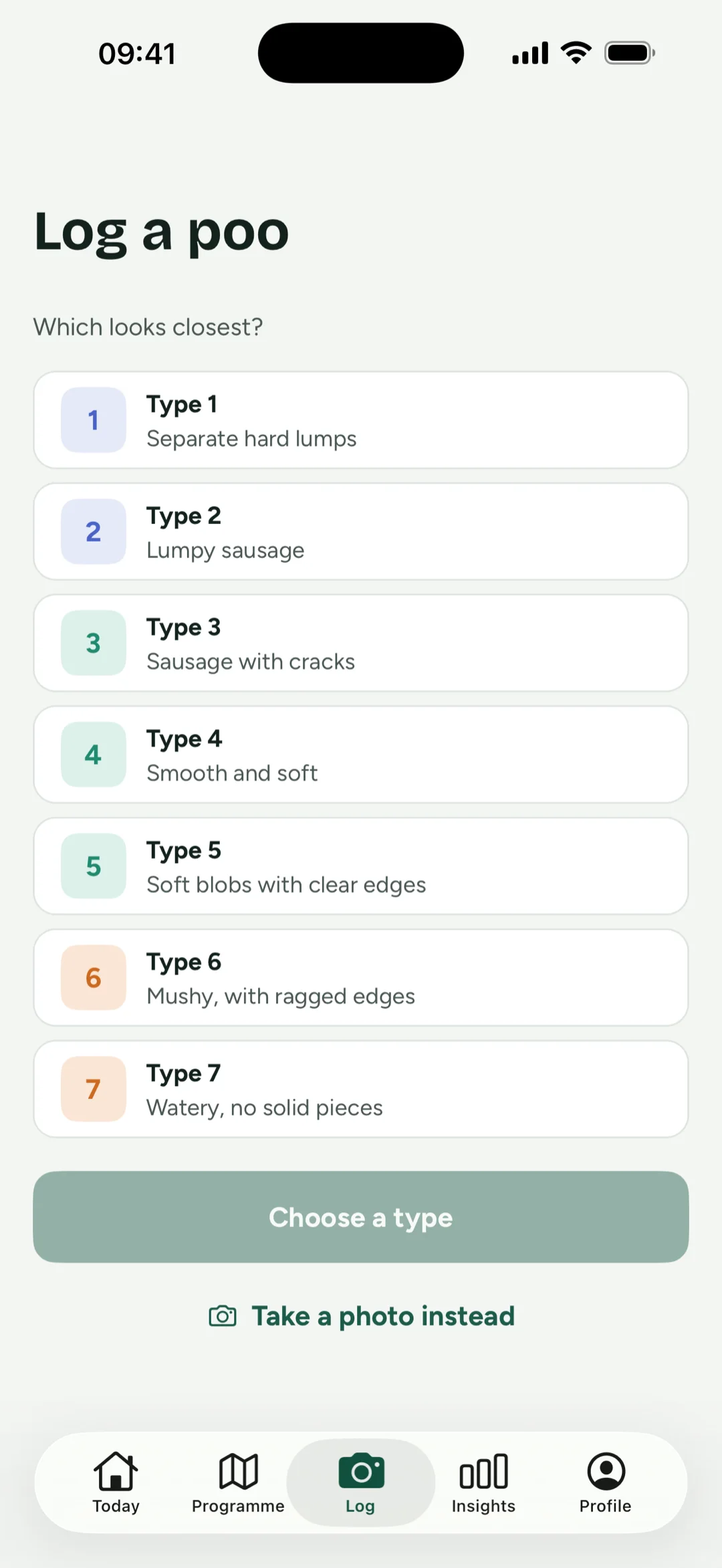
The MellowGut app uses this same chart. Tap a type, or use a photo: you get a suggested type and can change it if it looks wrong, and the photo is deleted straight after. After 7 days, the free Pattern Report shows your types over the week.
Sources
- Lewis SJ, Heaton KW. Stool form scale as a useful guide to intestinal transit time. Scand J Gastroenterol 1997;32(9):920–4 (1997)
- NHS England, Bristol stool chart (15 August 2023)
- Bladder & Bowel Community, Bristol Stool Form Scale (checked 13 October 2026)
- Hertfordshire Partnership NHS Foundation Trust, Bristol stool chart (checked 13 October 2026)
- NICE CG61, Irritable bowel syndrome in adults: diagnosis and management (updated 4 April 2017)
- Guts UK, Irritable bowel syndrome (May 2025)
- NHS, Bleeding from the bottom (rectal bleeding) (reviewed 12 April 2023)
- Guts UK, Poo-torial (checked 13 October 2026)
- NHS, Irritable bowel syndrome (IBS): symptoms (reviewed 17 March 2025)
Spotted a mistake? Email support@eduard-vlase.com and we’ll fix it. How we write our guides